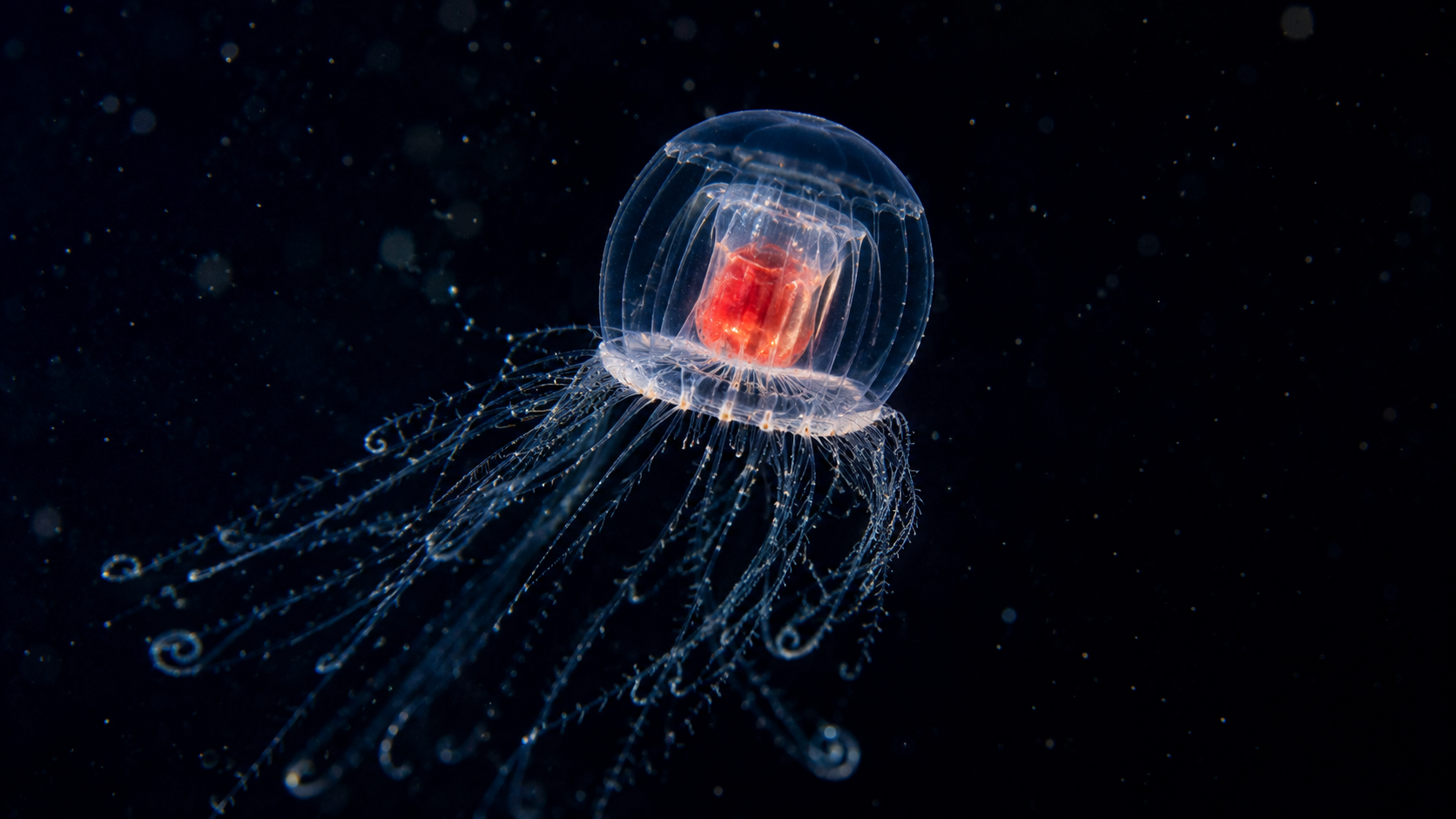
In the vast, unforgiving expanses of the world’s oceans, survival is a daily struggle. Every creature, from the smallest plankton to the largest blue whale, follows a strict biological rule: you are born, you age, and eventually, you die. It is the inescapable cycle of life. However, scientists have discovered a creature no larger than your pinky nail that completely ignores this rule. Its name is Turritopsis dohrnii, and it is biologically immortal.
The Ultimate Reset Button
To understand what makes this tiny, bell-shaped jellyfish so incredible, we first need to understand how a normal jellyfish lives. Most jellyfish start as a larva (planula) that swims until it attaches to the sea floor, becoming a plant-like stalk called a polyp. Eventually, this polyp buds off and releases baby jellyfish (medusae), which grow into adults, reproduce, and die. It’s a one-way street.
But Turritopsis dohrnii has a different plan. When an adult is injured, starving, or simply getting too old, it does something that looks like science fiction. It stops swimming, pulls its tentacles inward, and shrinks into a tiny blob of tissue. It then drops back down to the ocean floor and transforms back into a baby polyp. From that polyp, a new, genetically identical jellyfish is born. Imagine a butterfly turning back into a caterpillar, or an elderly human turning back into an embryo. It can repeat this cycle indefinitely.
How Does It Work? Understanding "Transdifferentiation"
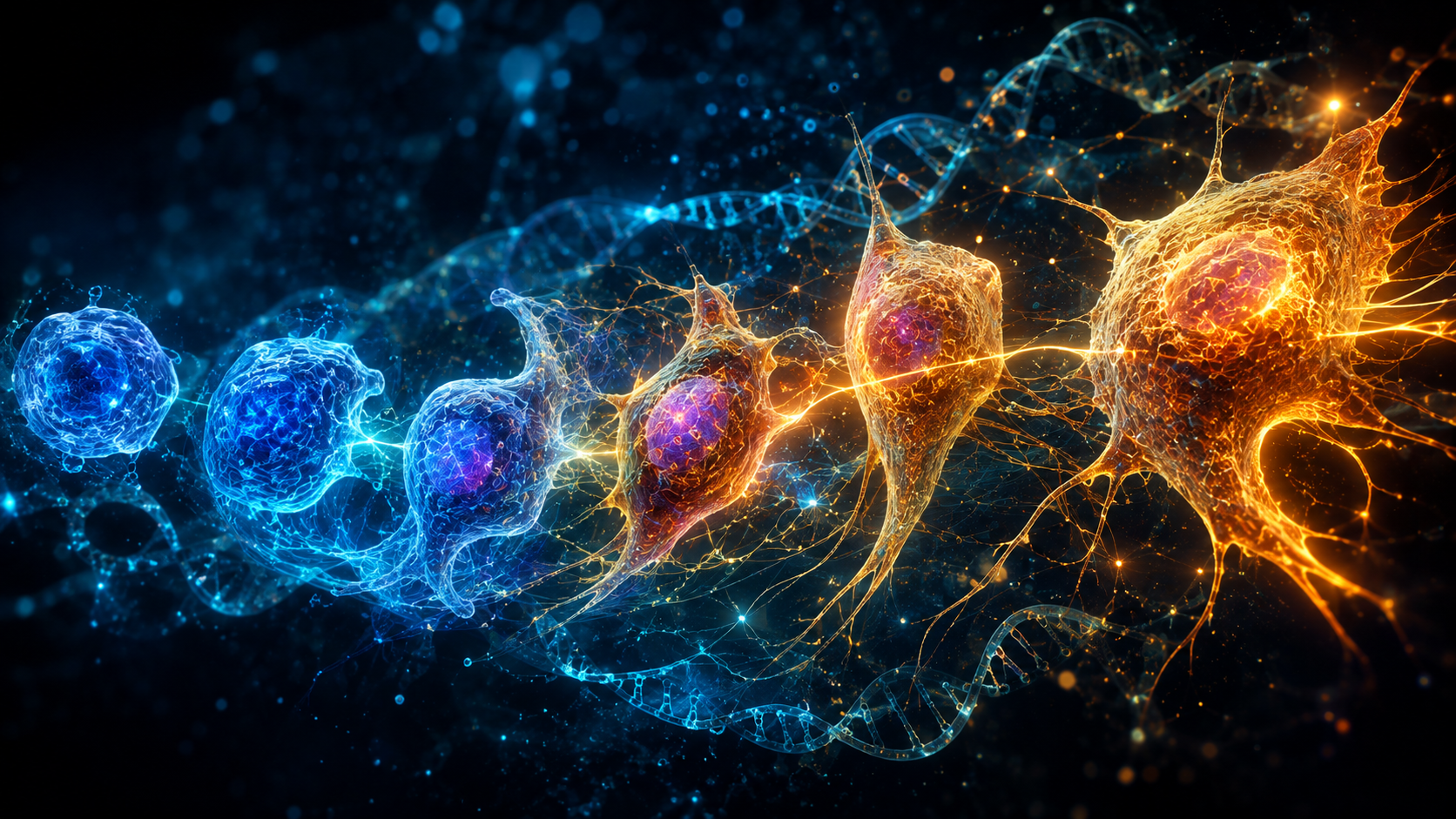
For decades, biologists were baffled. How can a fully developed adult body turn back into an infant state? The secret lies in a highly complex biological process called cellular transdifferentiation.
In humans and most animals, cells have very specific, permanent jobs. A muscle cell can only be a muscle cell; a nerve cell can only be a nerve cell. Once they are "specialized" as adults, they cannot change their careers. But the immortal jellyfish has the ability to erase the identity of its cells and give them completely new instructions.
The Simple Example: The Lego Castle
Let’s translate this into layman's terms. Imagine you have built a massive, intricate Castle out of Legos. The Castle represents the adult jellyfish. Suddenly, danger approaches, and you realize you need a Spaceship to escape, not a Castle.
For most animals, this is impossible. The Lego pieces are glued together. But for the immortal jellyfish, the pieces aren't glued. The jellyfish takes the Castle apart, brick by brick (breaking down its adult cells). It doesn't throw the bricks away; instead, it looks at a new instruction manual and uses those exact same bricks to build the Spaceship (the baby polyp).
In biological terms, a cell that used to be a muscle in the jellyfish's bell can literally rewrite its own DNA expression, turn back into a blank stem cell, and become a nerve cell or an egg cell for the new polyp. It is the ultimate form of biological recycling.
Are They Truly Invincible?
While the word "immortal" sounds like absolute invincibility, there is a catch. Turritopsis dohrnii is biologically immortal—meaning it will never die of old age. However, they are still physically vulnerable. A sea turtle or a larger fish can easily eat them, and they can succumb to oceanic diseases. They can be killed, but if left in a safe, predator-free environment, they could theoretically live forever.
What This Means for Humanity
Why are scientists spending millions of dollars studying a creature the size of a match head? Because if we can unlock the genetic switches that control transdifferentiation, the implications for human medicine are staggering.
Imagine if a patient suffering from a damaged heart after a heart attack could be given a treatment that takes their skin cells, reverts them to stem cells, and turns them into brand new heart muscle cells to repair the damage. By studying the immortal jellyfish, scientists hope to one day master the art of cellular reprogramming, turning the deep sea's greatest magic trick into a cure for age-related human diseases.
Scientific References & Sources
- The Biological Bulletin: Reversing the Life Cycle: Medusae Transforming into Polyps and Cell Transdifferentiation.
- American Museum of Natural History (AMNH): The Immortal Jellyfish: Can it really live forever?.
- PNAS (Proceedings of the National Academy of Sciences): Comparative genomics of Turritopsis dohrnii revealing the molecular basis of biological immortality.