
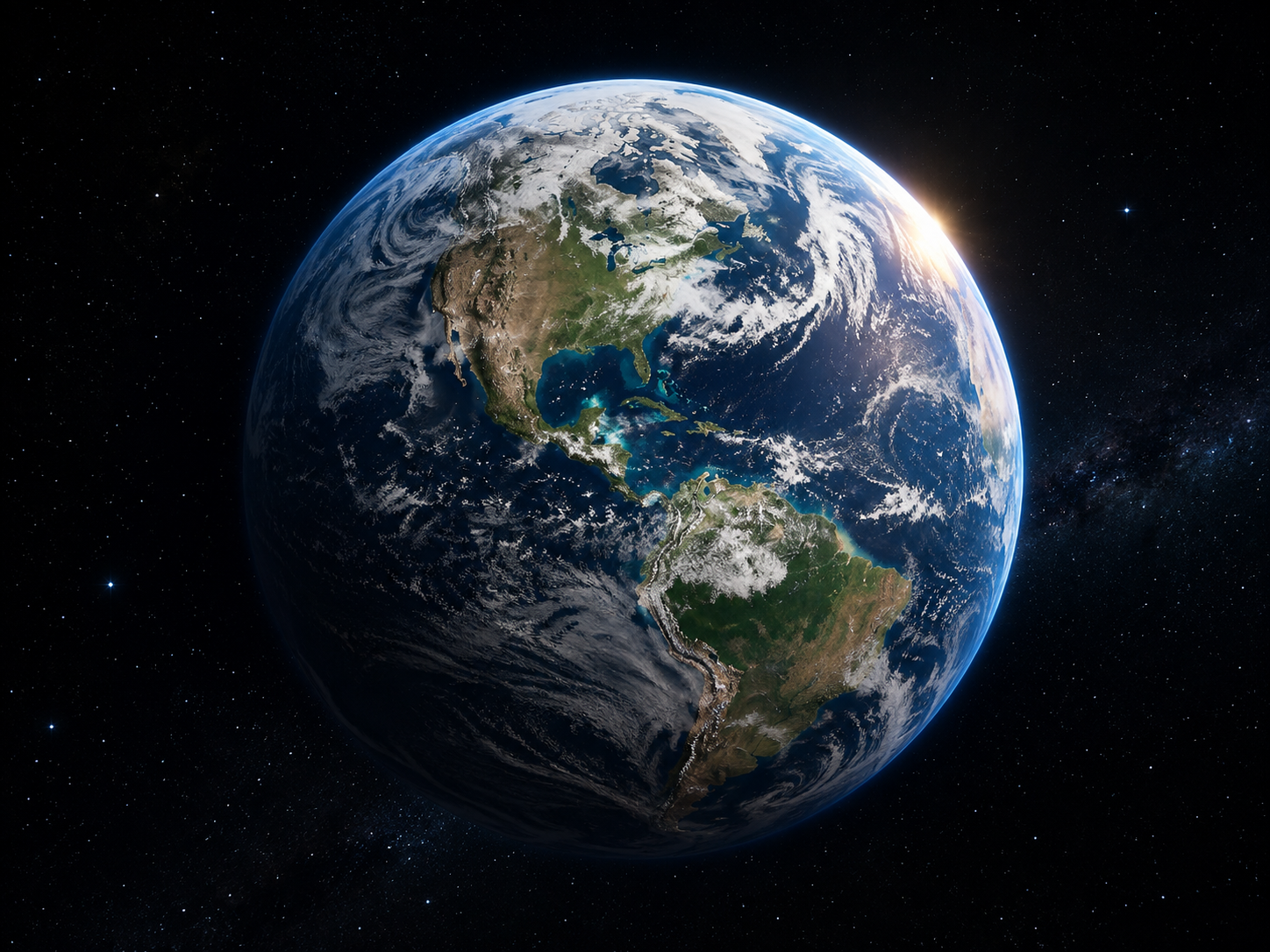
Earth is the only planet in our solar system known to support life. But what makes our planet so special? The answer lies in a delicate balance of conditions that have come together over billions of years to create the perfect environment for life as we know it.
The Goldilocks Zone
The first critical factor is our distance from the Sun. Earth sits in what astronomers call the "Goldilocks zone"—not too hot, not too cold, but just right for liquid water to exist on its surface. Water is essential for life as we know it, serving as a solvent for chemical reactions and a medium for biological processes.
If Earth were any closer to the Sun, water would boil away into space. Any farther, and it would freeze solid. This narrow habitable zone extends roughly from Venus's orbit to Mars's, but only Earth sits in the perfect spot to maintain liquid water consistently.
Our Protective Magnetic Shield
Our planet's size also plays a crucial role. Earth is large enough to maintain a molten core, which generates a magnetic field that protects us from harmful solar radiation. This magnetic shield, called the magnetosphere, extends thousands of miles into space and deflects the constant stream of charged particles from the Sun known as the solar wind.
Without this protection, Earth's atmosphere would have been stripped away long ago, leaving the surface exposed to deadly radiation. Mars, which lost its magnetic field billions of years ago, provides a stark example of what happens when this protection fails.
The Perfect Atmosphere
The composition of our atmosphere is another key factor. Earth's atmosphere contains the right mix of gases—primarily nitrogen and oxygen, with trace amounts of carbon dioxide and other gases. This composition allows for the greenhouse effect, which keeps our planet warm enough for life while preventing extreme temperature fluctuations.
Venus, despite being in the habitable zone, has a runaway greenhouse effect that has made its surface hot enough to melt lead. Mars has too thin an atmosphere to retain heat. Earth's atmosphere maintains the perfect balance, regulated by natural processes like the carbon cycle.
The Search for Life Beyond Earth
Despite our unique conditions, scientists continue to search for life elsewhere in our solar system and beyond. Mars remains a primary target, with rovers searching for signs of past microbial life. Europa, one of Jupiter's moons, may harbor a subsurface ocean that could support life.
Beyond our solar system, astronomers have discovered thousands of exoplanets, some of which may have conditions suitable for life. The search continues, driven by the profound question: Are we alone in the universe, or is life a cosmic phenomenon that arises wherever conditions allow?