
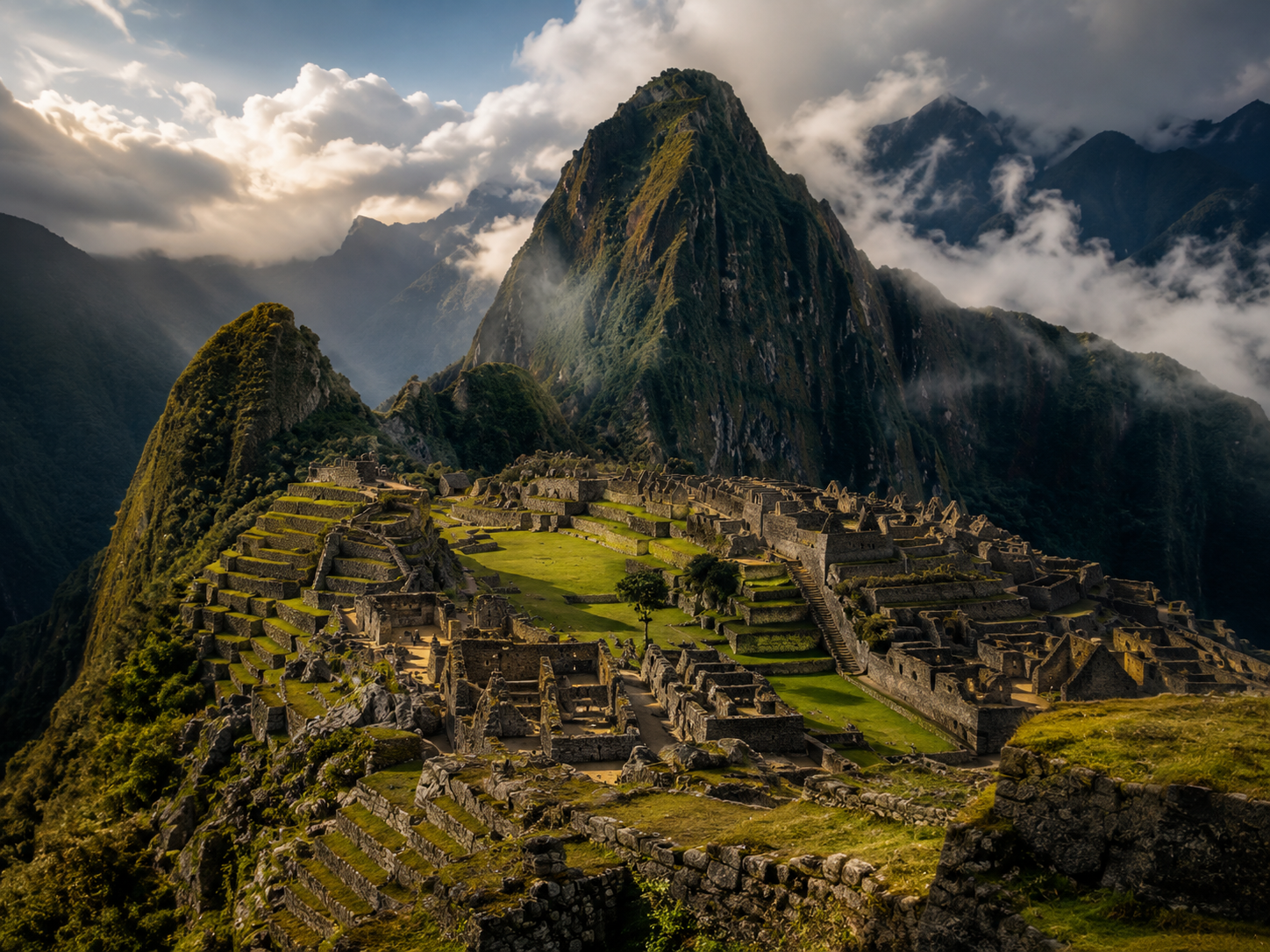
Machu Picchu is one of the most remarkable archaeological sites in the world. Built by the Inca Empire in the 15th century, it remained hidden from the outside world until its rediscovery in 1911. Perched on a mountain ridge 2,430 meters above sea level, this ancient city continues to captivate visitors and researchers alike.
A Royal Estate in the Clouds
Machu Picchu was likely built as an estate for the Inca emperor Pachacuti. It served as a royal estate and religious retreat, with precise astronomical alignments and sophisticated water management systems. The site was not a conventional city but rather a carefully planned complex with distinct sectors for different purposes.
The location was chosen for both strategic and spiritual reasons. Its remote location provided natural protection, while the surrounding mountains held deep religious significance for the Inca people. The city was positioned to align with important astronomical events.
Engineering Masterpiece
The construction demonstrates the Inca's mastery of stone masonry. The walls were built using a technique called ashlar, where stones are cut to fit together perfectly without mortar. The precision is so exact that a knife blade cannot be inserted between many of the stones.
This earthquake-resistant design has allowed the structures to survive centuries of seismic activity in one of the most earthquake-prone regions on Earth. The foundation stones were specifically designed to absorb and dissipate seismic energy.
Mysterious Abandonment
The site was abandoned during the Spanish conquest, though the Spanish never found it. Its isolation helped preserve it from destruction, making it one of the best-preserved Inca sites. The reasons for its abandonment remain unclear—some theories suggest disease, others propose Spanish conquest activities in the region.
The local Quechua people continued to know of the site's existence, but kept it secret from outside authorities. This protection may have saved Machu Picchu from the looting and destruction that befell many other Inca sites.
Modern Rediscovery and Legacy
Hiram Bingham rediscovered Machu Picchu in 1911, bringing it to international attention. Since then, it has become one of the world's most famous archaeological sites and a UNESCO World Heritage Site. The site continues to yield new discoveries about Inca civilization.
Today, Machu Picchu faces challenges from tourism and environmental factors. Conservation efforts balance public access with preservation of this fragile site. It stands as a testament to Inca engineering and serves as a bridge between ancient and modern worlds.