
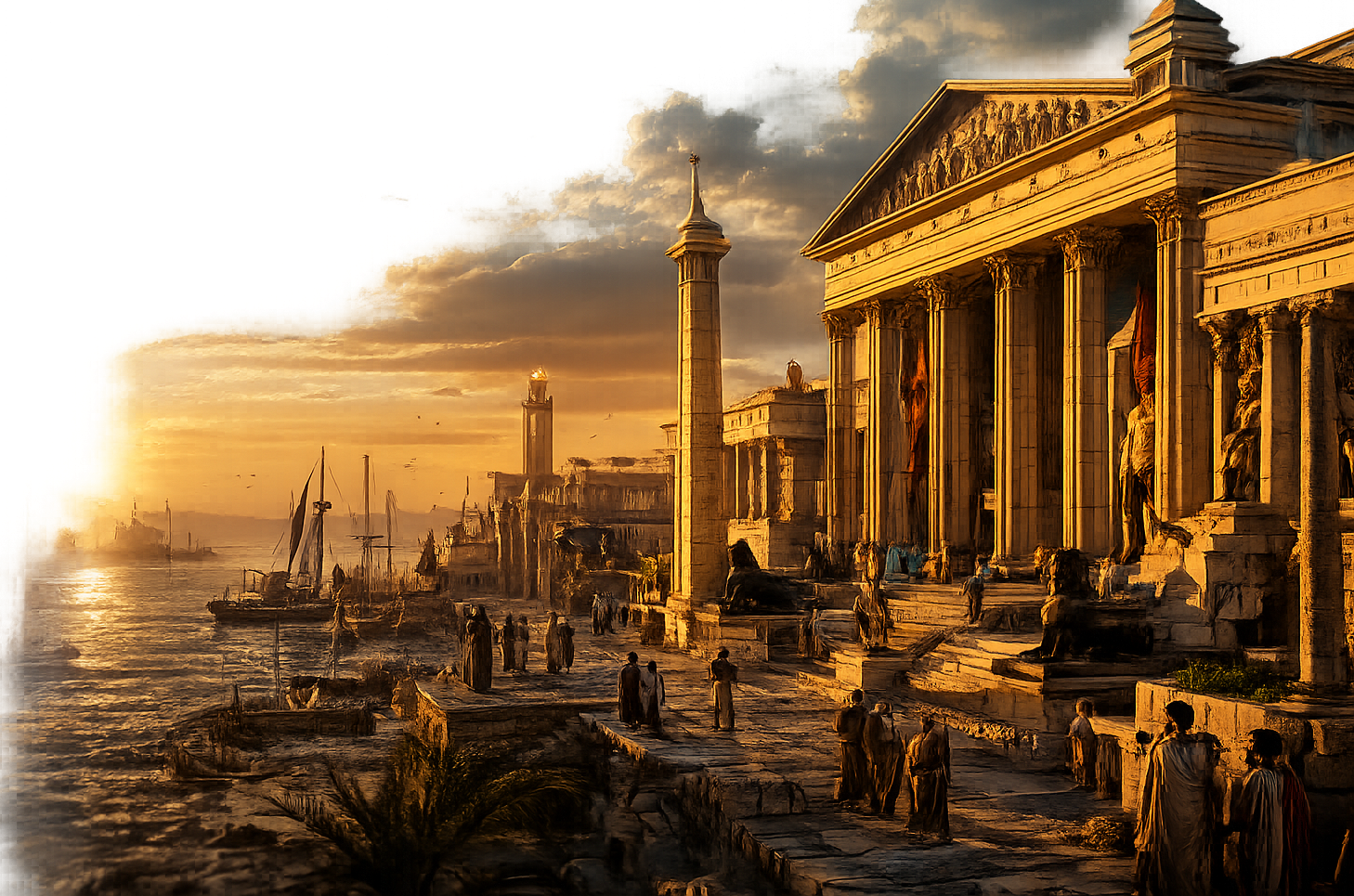
The Library of Alexandria was the largest and most significant library of the ancient world. It was part of a larger research institution called the Mouseion, which was dedicated to the Muses, the nine goddesses of the arts. For centuries, it stood as a beacon of human knowledge and scholarship, attracting the greatest minds of the Mediterranean world.
The Founding Vision
The library is believed to have been founded at the beginning of the 3rd century BC, during the reign of Ptolemy II of Egypt. It was conceived either by his father Ptolemy I Soter or by his successor Ptolemy III Euergetes. The ambition was clear: to collect all the world's knowledge under one roof.
This was no ordinary library. It was a research institution, a think tank, and a university combined. Scholars from across the known world were invited to live and study there, funded by the royal treasury. The library's mission was to collect, translate, and preserve works from every civilization.
The Scale of the Collection
It is unknown precisely how many scrolls were housed at any given time, but estimates range from 40,000 to 400,000 at its height. Each scroll represented months or years of work by scribes, philosophers, historians, and scientists.
The acquisition methods were both scholarly and aggressive. Ships arriving in Alexandria's harbor were searched for books. Any found were taken to the library, copied, and often the copies were returned to the owners while the originals stayed in the collection. This policy, while controversial, ensured that the library possessed the most comprehensive collection of texts in existence.
The Scholars and Discoveries
The library attracted some of history's greatest minds. Euclid developed his geometry there. Archimedes studied mathematics. Eratosthenes calculated the circumference of the Earth with remarkable accuracy. Hipparchus created the first comprehensive star catalog.
These scholars didn't just study existing knowledge—they created new understanding. The library was a place where medical advances were made, where astronomical observations were refined, where literary criticism was born. It was the Silicon Valley of the ancient world, but focused on knowledge rather than technology.
The Destruction and Legacy
The library's destruction is shrouded in mystery and debate. It may have been destroyed gradually over centuries, through fires, wars, and neglect. Julius Caesar may have accidentally burned part of it in 48 BC. Christian mobs may have destroyed remaining pagan works in the 4th century AD. The truth may involve all of these events and more.
Despite its physical destruction, the library's legacy endures. It established the model for the modern research university. It demonstrated the value of preserving knowledge across cultures and languages. It proved that bringing great minds together can accelerate human progress. In many ways, every library and research institution that followed stands in its shadow.